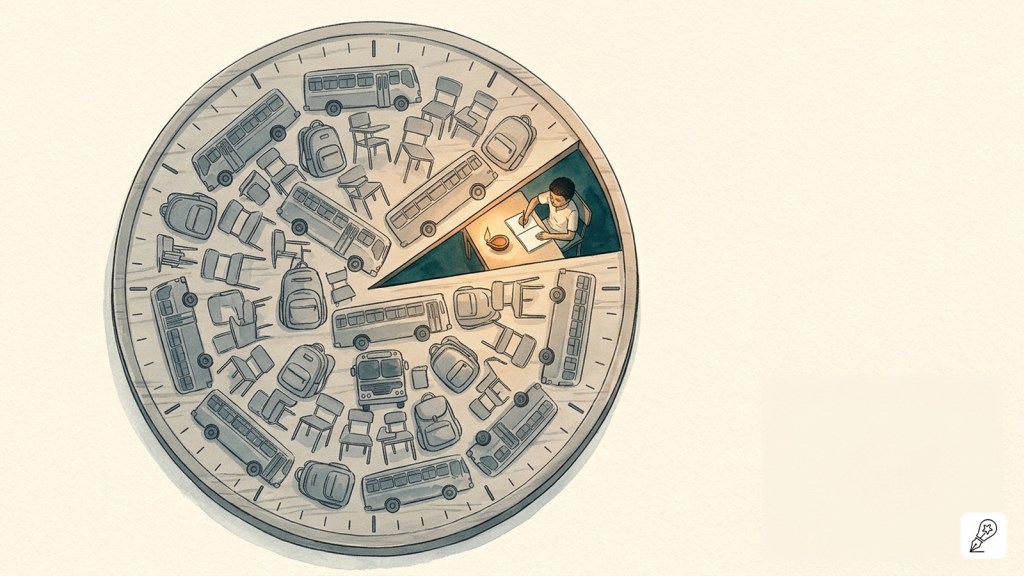
Private tutoring alongside school, which researchers call “shadow education”, is no longer an Asian peculiarity. It is a global industry. Sri Lanka is one of the places where it has become part of normal life for rich and poor families alike, and that is why we build for the one thing tutoring cannot supply: the hours a student spends studying alone.
A global phenomenon
Mark Bray, a leading researcher on private tutoring, puts it plainly in a 2025 report for UNESCO: “Private supplementary tutoring has become a global phenomenon, with significant uptake across a wide range of countries.” The report notes that in Egypt, Greece, Mauritius and Myanmar, “over 70% of students engage in private tutoring”.
It also cites an estimate that the global tutoring market was worth US$159 billion a year in 2023 and expected to reach US$288 billion by 2030. That is a market estimate, not a census, but it gives a sense of scale.
Sri Lanka beside its neighbours
The numbers below measure different things in different years, so they are not a league table. Read them as a sense of how common tutoring is.
- Sri Lanka. The same UNESCO report, drawing on UNESCO’s Global Education Monitoring Report, says shadow education “has become normalized across income groups”, with 2016/17 enrolment rates of 68% among the richest households and 60% among the poorest. Sri Lanka’s own response to a 2021 UNESCO survey, quoted in the report, describes the private tuition industry as “often perceived as a ‘second education system’”. Earlier household surveys show how fast it grew: the share of households with students aged 6 to 21 that spent on private tuition rose from about 23% in 1995/96 to about 64% in 2006/07.
- India. In India’s national education survey of 2017–18 (NSS 75th round), “nearly 20% of students” were taking private coaching, rising to about 30% at secondary level. The survey covered everyone aged 3 to 35 in education, so the school-age figure is the more telling one.
- South Korea. Spending on private after-school education by school students reached 27.5 trillion won in 2025, with 75.7% of students taking part, as reported by The Korea Times from the official survey. That was down from a record in 2024, ending a four-year run of increases.
The Korean figure is a useful reminder that the trend is not one-way. Spending can fall, and Bray’s report also warns that outright bans can push tutoring underground rather than end it.
The data is thin, and that is part of the story
When UNESCO’s Global Education Monitoring Report asked 205 countries and jurisdictions for data on private tutoring in 2021, Bray’s report notes that 143 of them, about 70%, provided no quantitative data. Sri Lanka has household survey figures, but few studies of how many hours a week tutoring takes, and almost none of what matters most to a student: how many hours are left to study alone. We set out what the few Sri Lankan studies found in The problem in Sri Lanka.
What this means for us
We do not build against tutoring. A good class can help a student a great deal, and in Sri Lanka it is how most families cope with a high-stakes exam system. We build for the gap tutoring leaves: the evening, the weekend, the hour after the last class, when a student has to make what they were taught their own.
That is where an AI study coach can help, if it guides rather than answers. It is available when classes are not, it works on the national syllabus, and it can put a student’s own mistakes in front of them again. How we keep it honest is the subject of Why our AI study coach shows where its answers come from.
A country where tutoring is a second education system is a demanding place to build. We think that is exactly why it is the right place to start. Contact us if you research shadow education or build for markets like it.
Sources
- Mark Bray, Whose visions for what learning? Perspectives, policies and practices in private supplementary tutoring, UNESCO (2025).
- National Statistical Office, India, Summary analysis of NSS Report No. 585: Household Social Consumption on Education in India, MoSPI.
- The Korea Times, Private education spending fell after hitting record high in 2024 (12 March 2026).
- Pallegedara, Demand for private tuition classes under the free education policy: evidence based on Sri Lanka, MPRA Paper 31969 (2011).


Leave a Reply