
Idasara Academy is built on one idea: that the most useful thing a student can carry out of school is knowing how their own learning works. We design for it through five pillars, each grounded in research on self-regulated learning and practised inside real subject work.
Why not just a chatbot?
Because answers are not the bottleneck. A student with a chatbot can get an answer in seconds. What a student needs is the habit of working an idea out, checking it, and coming back to what they got wrong.
The research shapes how we build that habit. The Education Endowment Foundation’s guidance report on metacognition and self-regulated learning finds “little evidence of the benefit of teaching metacognitive strategies in generic ‘learning to learn’ or ‘thinking skills’ lessons”, because these skills are context-dependent. So we do not teach learning how to learn as a subject. It lives inside the quiz a student just got wrong and the topic they are studying tonight.
The aim, in the same report’s words: “Self-regulated learners are aware of their strengths and weaknesses and can motivate themselves to engage in, and improve, their learning.”
The five pillars
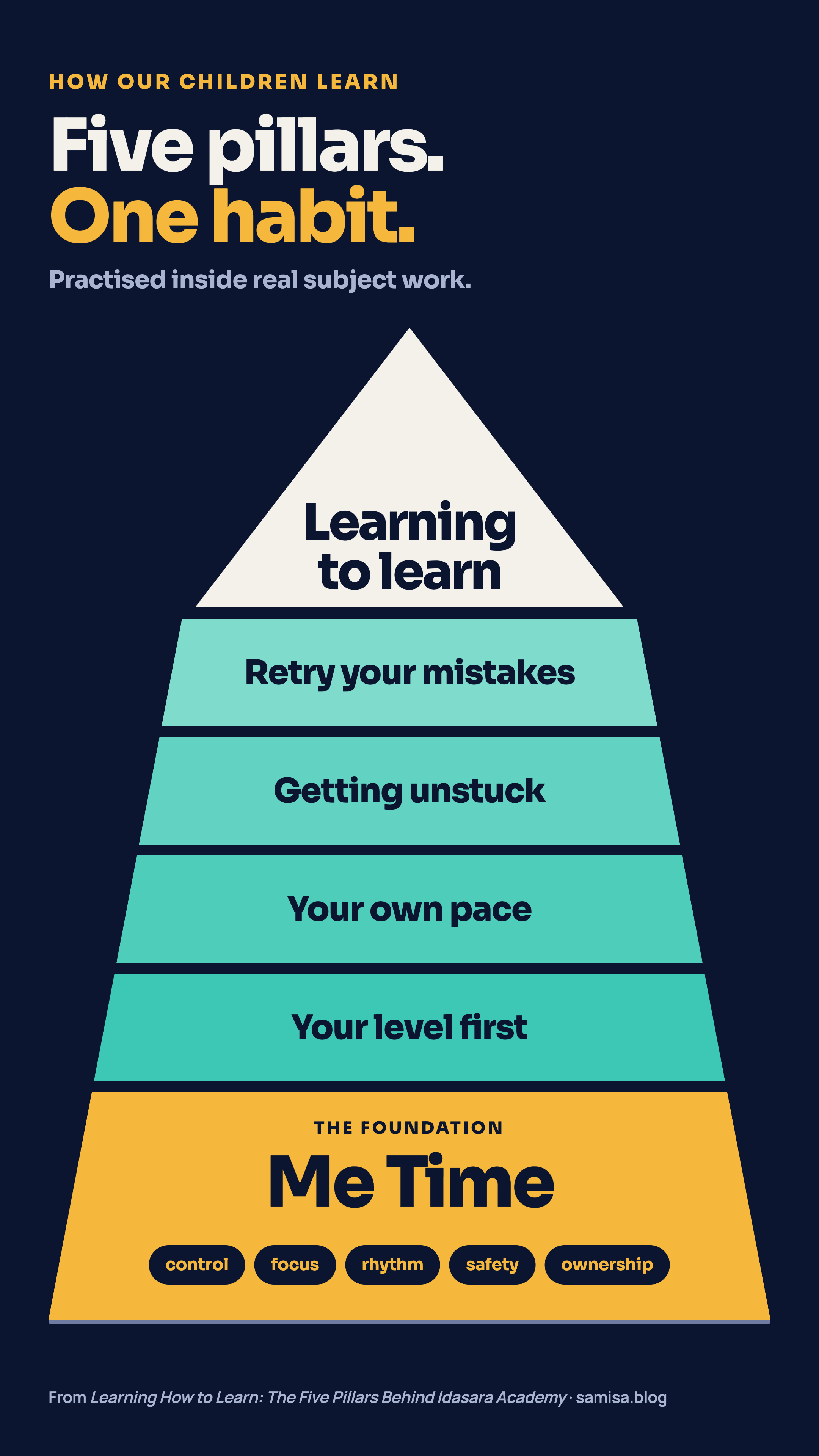
| Pillar | The learning idea | What the research says | How the product carries it |
|---|---|---|---|
| 1. Me Time | Learning deepens when the student owns some of it, in a place where being wrong costs nothing. | Choice raises motivation and effort, though less for choices that matter for learning. Errors made in low-stakes practice and then corrected can help later performance. | A Learning Autonomy level (Guided, Shared, Self-directed, Independent) sets how much the app plans and reminds. It comes from how the student studies, never from what the family pays. |
| 2. Start at your level | Teach from where the learner is, not where the syllabus says they should be. | Teaching at the Right Level programmes in India doubled the share of children who could read a story, under specific conditions. | A short quiz shows a student their weakest topics first, and those gaps seed their practice. |
| 3. Your own pace | Understanding takes the time it takes, and spaced study holds better than cramming. | Spaced practice is rated of “high utility”. Pure self-pacing weakens mastery learning, so pace needs guardrails. | A daily plan the student can reorder as autonomy grows, and a pace signal that reports pace without setting it. |
| 4. Getting unstuck | Try first, then see the reasoning, then explain it back. | Self-explanation helps on average; problem-solving before instruction helps for new concepts, though not for every age or skill. | After a miss, the student is asked what went wrong; help grows from a guiding question to a method hint to a worked example. A “Teach It” mode lets the student explain a topic to an AI classmate. |
| 5. The Mistake Bank | A mistake shows what to study next, if it is corrected and retried. | Errors followed by corrective feedback help learning, and recalling from memory beats rereading. | Wrong answers collect by subject and topic, and practice draws on them first until the student gets them right. |
How honest is the evidence?
We read it carefully and we state its limits. Most of these studies come from outside Sri Lanka. Several are laboratory results, not classroom ones. None of them tested an app, including ours. They support the design; they are not a guarantee of a grade, and we do not promise one.
What it adds up to
A student who knows what to study today, practises from memory, gets unstuck without being handed the answer, and comes back to every mistake. That is a habit a student keeps after the exam, and it is the habit our product is built to practise. See what ships today →
The full essay, with what a parent can try tonight for each pillar: Learning How to Learn: The Five Pillars Behind Idasara Academy, by our founder on samisa.blog.
Talk to us: contact

