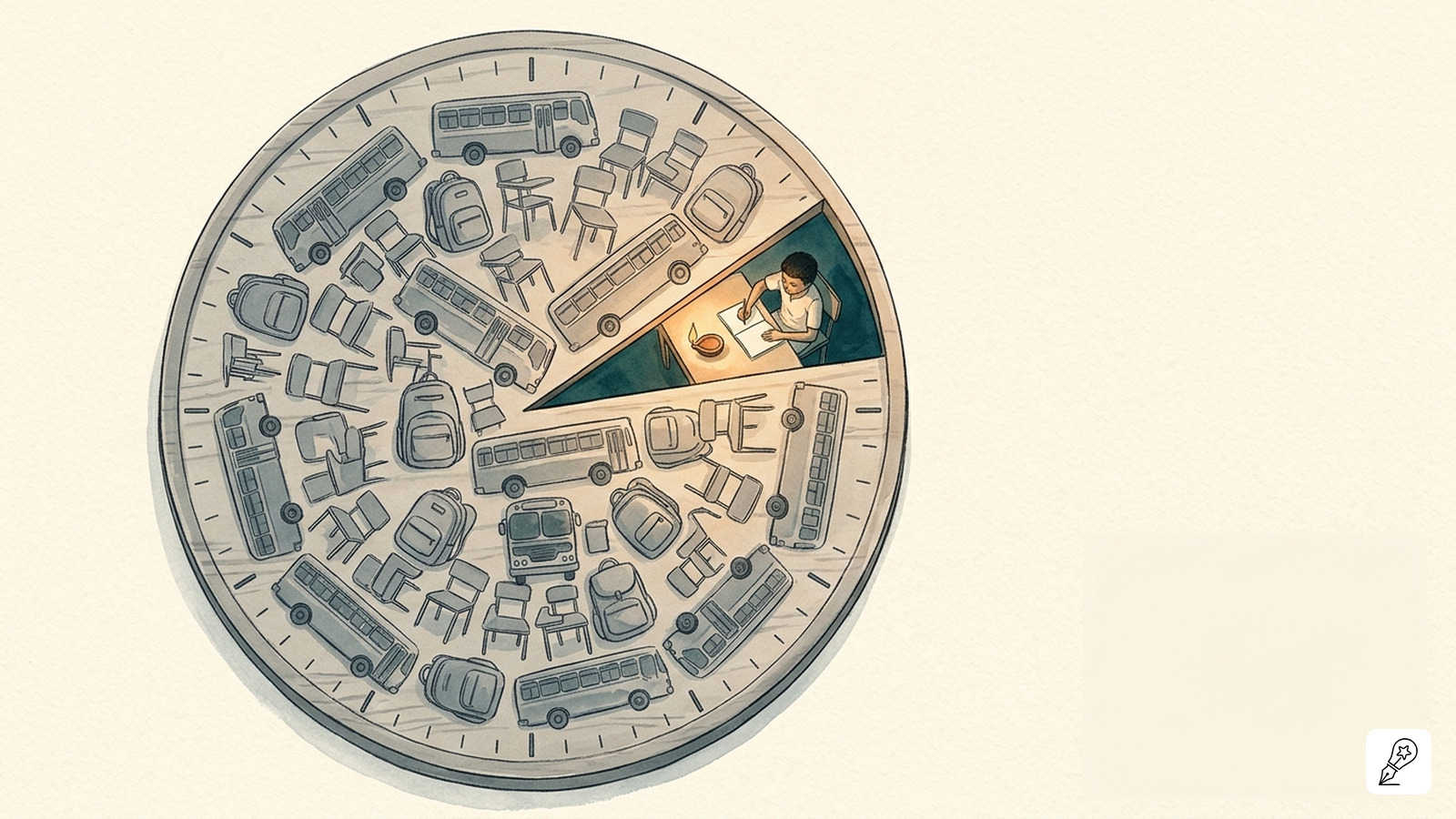
Our thesis: Sri Lankan students do not lack classes. They lack time to make what they are taught their own. Private tuition has become a social norm that fills the week, and AI is now arriving with the same risk, more help that does the thinking for the student. We build for the hours a student spends alone.
How does schooling work in Sri Lanka?
Students follow a national syllabus and sit two national examinations: the G.C.E. Ordinary Level (O/L) at the end of Grade 11 and the Advanced Level (A/L) at the end of Grade 13. The A/L result decides university entrance, so the stakes are high and the competition is intense.
Alongside school runs a large private-tuition market, the “shadow education” that researchers study across Asia. In Sri Lanka it is no longer optional for most families.
How common is tuition?
Very. In Sri Lanka’s Household Income and Expenditure Surveys, the share of households with students aged 6 to 21 that spent money on private tuition rose from about 23% in 1995/96 to about 64% in 2006/07. Mark Bray and Ora Kwo, in their 2014 monograph on regulating private tutoring for the public good, name Sri Lanka as a place where shadow education “has become entrenched in society and has become a social norm”.
The government acknowledges the cause. In February 2025, Prime Minister Harini Amarasuriya said that “the tuition industry has flourished due to shortcomings in the education system”, and that schools must reduce the reliance on it. In September 2026 the Education Ministry told The Morning that it cannot regulate tuition classes, because they are private institutes that are not registered anywhere.
What does it cost a student?
Time, above all. A University of Peradeniya study of A/L Biology students in Gampaha district (2006) found they spent 12.16 hours a week in tuition on average, across one to seven classes, and travelled 67.8 km a week to reach them. Bray and Kwo, reporting a 2009 Sri Lankan study, describe senior secondary students “commonly spending 15 to 21 hours a week in extra classes”.
These figures are old and come from small samples. The number nobody has measured is the one that matters most: how many hours are left for a student to study alone.
Why do those hours matter?
Because that is where learning is kept. Laboratory research on memory finds that students who try to recall material from memory remember more days later than students who simply reread it, and a 2013 review of ten study techniques rated practice testing and spaced practice of “high utility”, and rereading of “surprisingly low utility”. A class can explain an idea. Only the student, studying alone, can make it last.
Tuition often helps. A 2020 review of tutoring experiments found real gains from structured, close tutoring. Our argument is not against teachers or classes. It is for the hours between them.
Where does AI come in?
AI makes the problem sharper, in both directions. In a study of nearly a thousand high school maths students in Türkiye, those who had practised with a standard chatbot did 17% worse on an exam taken without AI than students who never had it. A tutor version that gave teacher-designed hints instead of answers largely mitigated that harm. AI that does the thinking can weaken a student. AI that guides the thinking can help.
Sri Lanka also needs the help. Education Ministry data reported by The Morning showed 40,185 teacher vacancies unfilled at the end of 2025.
What we build in response
An AI study coach that guides rather than answers, works on the national syllabus, and protects the student’s own study time: a plan for the day, practice from memory, mistakes that come back, and help that asks the student to think first. How the method works → · What ships today →
Most of the learning research cited here comes from outside Sri Lanka, and the Sri Lankan tuition studies are small and dated. We cite them for what they show, not more.
Further reading from our founder, on samisa.blog: Bring Back the Time: What Tuition Hopping Takes From Our Children · Double Reduction, Five Years On · AI Does Not Eliminate Good Teachers
Talk to us: contact

